Updated July 2026: Pricing and the streaming model have changed since this post was written in 2022. Streams are no longer charged in points. They’re metered separately on stream-minutes and GB. For the current plans and rates, see bitquery.io/pricing and the Points docs. The explanation below has been refreshed to match.
Bitquery indexes more than 1 Petabyte of structured blockchain data today and opens APIs to access this data at scale.
To achieve simplicity, we chose GraphQL, which provides a single interface to access all our data. Using our GraphQL IDE, you can access any blockchain data through a single GraphQL endpoint and get a chain’s latest block height, follow money trails, pull DEX trades across every chain we support, and more.
However, every query doesn’t consume the same amount of resources. Some queries need 100 records to return results; others crawl through billions. Some return data from cache; others might use large amounts of memory to calculate results.
A single GraphQL interface is convenient for the user, but it makes the product hard to price. We can’t charge purely by number of API calls, because every call is different and consumes resources differently.
Solution
It’s only fair to measure the resources each request consumes and price based on that. That’s exactly what Points do.
Points
When you run a query on our infra, we calculate the resources it consumes. Points are then derived from the price of those resources:
Points = Resources consumed × Price per unit
The algorithm and resource prices may change over time, but pricing is based on Points, not raw API call count.
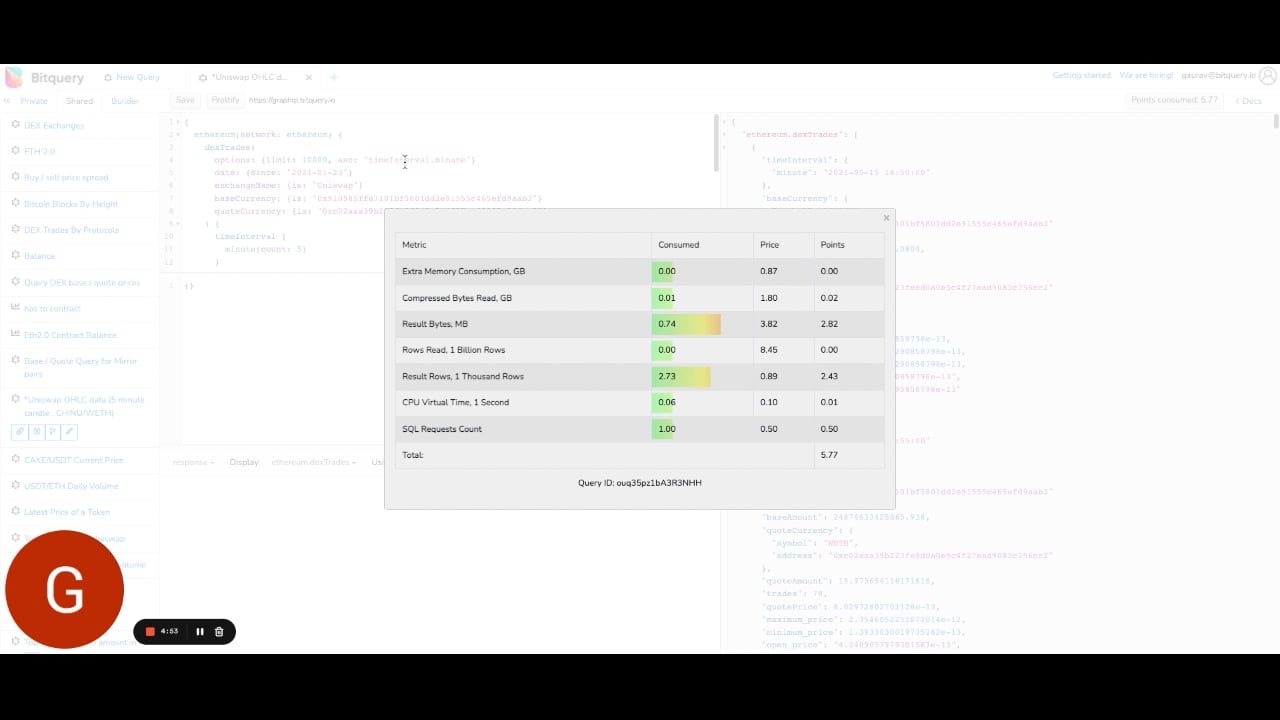
Points for real-time data
If you query the real-time dataset for any chain, it costs a flat 5 points per cube, regardless of query complexity or how much data you request. Queries against archive/historical data are priced by resources consumed, as described above.
How streaming is priced now
Streams are no longer charged in points. WebSocket streaming is metered separately on two meters:
- Stream-minutes — one stream connected for a full month = 44,640 minutes.
- GB — data pushed over the socket.
Each paid plan includes a stream-minute and GB allowance, and you can top up with flat-rate add-ons ($20 / 100k stream-minutes and $8 / GB, bought yearly). Kafka streams are separate again: a fixed-cost, unmetered delivery option on Enterprise.
(Note: the original 2022 version of this post described streaming as “40 points per minute” with “1.75M points/month” bundled into commercial plans. That model has been replaced by the stream-minutes + GB metering above.)
Current plans
Pricing is now self-serve. Upgrade in a few clicks, no sales call needed:
- Personal — $49/mo ($39 billed annually): 100k API points/mo, full GraphQL schema, 9 core chains, no streaming. Personal/non-commercial use.
- Pro — $99/mo ($79 billed annually): 1M points, 100k stream-minutes, 5 GB, 100 concurrent streams, trading-data streams.
- Scale — $299/mo ($239 billed annually): 5M points, 2M stream-minutes, 50 GB, 1,000 concurrent streams, all onchain + mempool streams.
- Enterprise — custom: complete history across 40+ chains, unlimited streaming, Kafka fixed-cost, S3 bulk export.
Add-on points are $40 / 1M (yearly) or $50 / 1M (monthly). Every paid plan includes a 7-day free trial with full live WebSocket streaming, no card required.
See full details on the pricing page.
Benefits of Points
- All datasets are available on every self-serve plan.
- Points incentivize query optimization, so everyone benefits.
Checking your usage
Points and usage are visible throughout the IDE — under your profile, API usage, and billing. If your point consumption is high, optimizing your queries (narrower date ranges, lower limits, fewer addresses) is the fastest way to reduce cost.
If you have questions or need help optimizing, reach out on our community forum or Telegram, or see the Points documentation.